Those who love me
A Sermon drawing on 1 Peter 3:13–22 · John 14:15–21
"'People brought ashore opposite church cry for water,' he wrote. 'Old man crawling, in his filthy shirt, out of bed on hands and knees, with his pot to get water out of a dirty ditch.'" (Reisner, Strangers and Pilgrims: A History of the Anglican Diocese of Quebec, 1793–1993 131)
As our Diocesan Historian M.E.B. Reisner writes:
"Bishop G. J. Mountain scrawled these notes as if to fix more firmly in his mind the misery he had witnessed during his second tour of duty at Grosse-Île, in the horror-filled summer of 1847." (Reisner, Strangers and Pilgrims: A History of the Anglican Diocese of Quebec, 1793–1993 131)
It was a horror-filled summer. Ships filled with refugees from the famine in Ireland crossed the Atlantic, arriving in desperate and diseased condition. To prevent the spread of typhus fever, the state forced the incoming ships to disembark their passengers at Grosse-Île, the quarantine island northeast of Quebec City. Those refugees who recovered from the illness would be moved on to the mainland for settlement.
Many, however, would not make it. Many, like the old man Bishop Mountain saw struggling to drink, would die.
Hundreds. Thousands.
But the dead wouldn't just be the refugees. They would also be the people who helped them.
In 1847, Bishop Mountain put out a call to all the clergy, looking for volunteers to take week-long shifts on the island to care for the sick and to bury the dead. He asked for volunteers because anyone who took up that call would risk their own life in doing so.
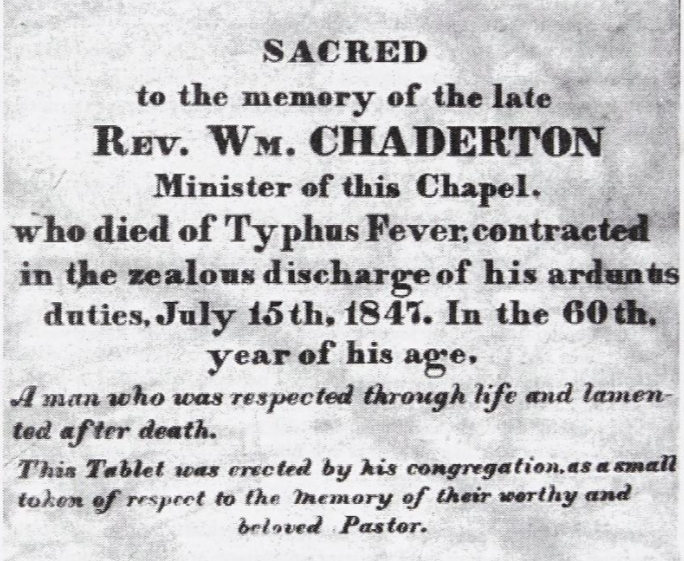
Seventeen priests in our diocese took up that call. Of those seventeen, almost all would contract the fever. Three of them, Richard Anderson of Upper Ireland, Charles Morris of Port Neuf, and William Chaderton of Quebec City, died.
They died caring for the sick.
They died burying the dead.
They died for the sake of helping refugees—refugees that many feared, that many rejected, that many wished would be sent away.
How do we make sense of these people's sacrifice? How do we make sense of this fearless commitment to serve, to serve even at the cost of one's own life?
In our second reading, from the First Letter of Peter, we hear these words directed toward a community of disciples who were likely undergoing persecution:
"Do not fear what they fear, and do not be intimidated, but in your hearts sanctify Christ as Lord." (1 Peter 3:14–15)
Do not fear, because death is not the end of our story.
Do not be intimidated, because if death is not the end of our story, then the empire's greatest weapon—its power to destroy—is not absolute. It does not have the last word.
Because Christ is Lord—not the principalities and powers of suffering and death.
This led the early Christians to do some scandalous things, some deeply countercultural acts in Greco-Roman society. When people would abandon the sick in times of plague, would leave the dead unburied, the early Christians were known to stay. They would care for the sick and they would bury the dead—even when the sick and the dead were not their own.
These Christians were known to be fearless. Fearless in love. Fearless in service.
And holding Christ as their Lord, they were asked to account for it:
"Always be ready to make your defense to anyone who demands from you an accounting for the hope that is in you." (1 Peter 3:15)
First Peter assumes that these disciples are living in ways that will cause the world to ask:
Why would you take that risk?
Why would you make that sacrifice?
Why would you bear the cost of that service?
Give us an "accounting for the hope that is in you."
Hope.
It is a fearlessness founded on hope.
I don't know about you, but these days sometimes seem pretty bleak, kind of the opposite of hope. I often think we live in a world every bit as oppressive and deadly as the world of the Roman Empire. We see war. We see disease. We see famine. We see refugees, just as surely as our ancestors did.
What will be our witness?
How will our lives testify to the hope that is within us?
What will be our fearless service?
In our reading from the Gospel of John, I think Jesus points us toward an answer.
Jesus says that while the world will no longer see him, we still can. But there is a catch. Our vision of Jesus is connected to our moral vision:
"They who have my commandments and keep them are those who love me; and those who love me will be loved by my Father, and I will love them and reveal myself to them." (John 14:21)
Our moral vision and our vision of Jesus are connected. Each informs the other. Sanctifying Jesus as the Lord of our heart, learning from his deeds, following in his example, shapes how we see the world. And who we see, who we care for, who we attend to—that, in turn, reveals Jesus to us here and now.
The writer and philosopher, Iris Murdoch once wrote:
"…our ability to act well 'when the time comes' depends partly, perhaps largely, upon the quality of our habitual objects of attention." (Murdoch, The Sovereignty of Good, 55)
What we habitually pay attention to shapes our moral vision. It shapes who we are capable of seeing, and what we are capable of doing when the moment of decision arrives.
The French Philosopher Simon Weil turns this attention into a spiritual practice,
"…prayer consists of attention." (Weil, Waiting for God, 57)
"Not only does the love of God have attention for its substance; the love of our neighbour, which we know to be the same love, is made of the same substance. Those who are unhappy have no need for anything in this world but people capable of giving them their attention." (Weil, Waiting for God, 64)
And then, she says this:
"The love of our neighbour in all its fullness simply means being able to say to him: 'What are you going through?'" (Weil, Waiting for God, 64)
Perhaps that question, "What are you going through?" addressed to another, followed by focused listening, can itself be a form of prayer.
So, who are you giving your attention to? To whom might you be called to attend? Who might you ask this week: What are you going through? And will you take the time needed to listen to the answer?
This calling to attend is the witness of our ancestors.
When the widowed and the orphaned were abandoned in Greco-Roman society, it was the community of disciples—the church—who would attend to them.
When plague victims and lepers were shunned, when the dead were left unburied, it was the community of disciples—the church—who would attend to them.
This was the early church's growth strategy. But it wasn't about growth in numbers. It was a growth in moral vision, a growth in character—a growth made possible through their attention to Jesus, and their attention to those on the margins.
This is the history of our people over a thousand years ago.
In Richard Anderson, Charles Morris, and William Chaderton, we see this same fearless love alive in our own diocese, a hundred and seventy-nine years ago.
And this history, this legacy, is ours to inherit today.
Every time the hungry are fed.
Every time the thirsty are given drink.
Every time the stranger is welcomed.
Every time the sick and imprisoned are visited.
Every time those on the margins are clothed.
Every time we attend to the least, the last, and the lost—we attend to Christ.
"They who have my commandments and keep them are those who love me…" (John 14:21)


